Case Study Overview
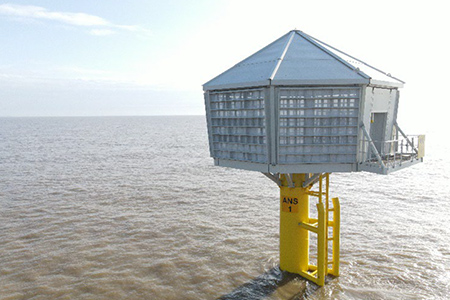
In June 2023 Red7Marine completed an £11,000,000 project involving the installation of three nearshore artificial nesting structures along the East Coast of England, on behalf of Ørsted. The structures were required as a part of the Development Consent Order for the Hornsea 3 Offshore Windfarm as an ecological compensation measure for a vulnerable seabird species – the Black-legged Kittiwake.
Our involvement in the project began during the latter stages of the detailed design process. Following a short period of ECI, we were awarded the contract to fabricate and install three complete structures as Principle Contractor for the scheme. Two of the artificial nesting structures (ANS) are located approximately 1km from the shoreline of South Beach, Lowestoft, and the third is 1.4 km from the shoreline of the RSPB Minsmere Nature Reserve.
At a glance
- Location: Lowestoft, Minsmere
- Plant used: Haven SeaChallenger Jack-up Barge, Haven SeaStabler
- What we did: Red7Marine installed 3no. artificial nesting structures for Orsted off the coast of Lowestoft as a compensation measure for kittiwakes as a part of the Hornsea Three Offshore Wind Farm development.
CHALLENGE
Red7Marine was responsible for managing the fabrication process. This involved several interfaces with the client’s designer, Royal Haskoning and four different supply chain partners.
Three 1.72 metre diameter steel monopiles with internal grout sleeves were fabricated in Middlesborough by Readman Steel, these act as the foundation for the structures. Each monopile weighs in excess of 30t and now installed, has an embedded depth below seabed of 30m.
The upper pile sleeve is fitted with two vertical steel tubes for vessel berthing and a ladder has been fabricated for access into the structure. A vessel accessing the ANS will push onto the two bumper bars so that safe access to the ladder can be achieved. These elements were fabricated in Great Yarmouth by Armultra.
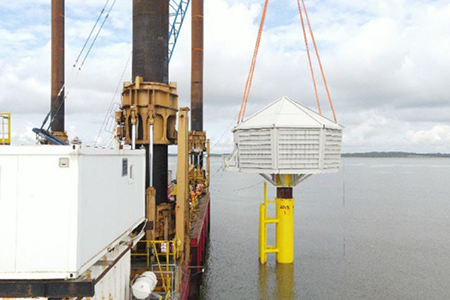
The nesting structures themselves were fabricated in Fareham by FourTees Engineers. They are made up of several elements including bolted items, lengths of beam, structural elements and a barn door. All elements were delivered to the SLP Berth in the Port of Lowestoft where the structures were bolted together and assembled.
The Solution
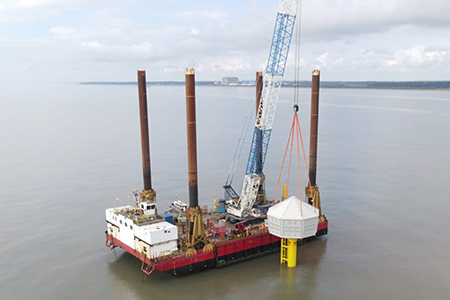
To construct each ANS, we utilised two jack-up barges from our fleet, a 1,000t unit and 3,000t unit.
The Typhoon 3000 jack-up barge was chosen as the installation vessel due to its size and scale, it could transport at least two full structures out to the job site without resupply.
The construction sequence involved lifting the monopile through a bespoke piling gate fitted to the jack-up barge and using a vibratory hammer to first install the pile to refusal.
Strict controls were introduced in the form of soft start procedures and Marine Mammal Observation to mitigate against impact on noise and vibration to local wildlife. We completed a 30-minute observation period for marine mammals prior to commencing piling operations. We followed a soft start procedure for every foundation that we installed, and we had the ability to monitor the energy output from the hammers real-time with full data logging functionality, to prove the equipment did not exceed 20% power during the soft start procedure. This proved to be valuable later on in the project.
After the pile was initially set, A drop hammer was used to advance the pile to the required toe level. Following this, the topside jackets were grouted into position and the topside structures lifted and bolted onto structure complete with navigation aids and monitoring systems.
As an offshore project, this was subject to a high degree of third-party engineering checks such as cat 3 checks. Our in-house design team carried out extensive temporary works to install piling gear onto our jack-up barge and sea-fastenings to accommodate the safe transit of offshore assets.
The lifespan of the Proposed Development is expected to be circa 40 years. Each structure has approximately 500 nesting spaces to introduce enough new chicks into the population. The first chicks have now hatched at the structures. The nesting structures will be monitored every year to count the number of birds, occupied nests, and their productivity. In addition, monitoring systems are in place for the existing kittiwake colonies in Northeast England and East Suffolk and the results will all be shared with local groups such as the Lowestoft Kittiwake Partnership.
These nesting structures are required to support this important and vulnerable species and will enable Hornsea 3 to be built and generate clean, green electricity. This is the first project of its kind and required careful planning and consideration to ensure its success.