Case Study Overview
Red7Marine first initiated engagement on the Bridgwater Tidal Barrier project back in November 2021 during the onboarding stage of the detailed design with the Collaborative Delivery Framework Partners Atkins and Kier. Our real involvement then began in November 2022, where we started conversations with Kier acting as a specialist contractor to advise on the piling methodology to help determine the best method for constructing the Tidal Barrier. This led to Red7Marine carrying out the test pile installation on behalf of Kier in August 2023 and flood defence works ahead of the main foundation install for the tidal barrier.
At a glance
- Location: River Parrett, Somerset
- What we did: Red7Marine has been working with Kier for the development of the Bridgwater Tidal Barrier project, this has included installation of a test pile and flood defence enabling works, ahead of the main foundation build in April 2025.
The Challenge
Ahead of the site work, Red7Marine produced a drivability analysis and looked at various noise mitigation measures working with the Kier team to find the best solution.
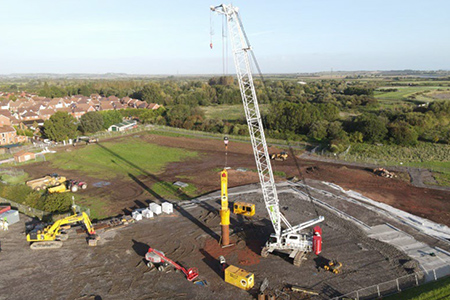
The main test pile works involved installing 1no. 1420mm diameter (19mm section thickness) tubular foundation pile (as a part of the Tidal Barrier foundations) and 2 sets of AZ 28-700 sheet piles and single 610 x 205 x 238 H Piles to form the combi-wall cofferdam. The site team mobilised to the project laydown area and received all plant and supply items to build the crawler crane necessary for the installation. The excavator then prepared the piling area, ensuring there was a reception pit approximately 1m deep which was then filled with sand. The excavator pile grab received the pile suspended from the crawler crane. The self-weight of the pile was able to reach ‘toe’ level into the sand reception pit. The crane then used the vibro hammer on the tube
until refusal.
The crane picked up the CG300 and placed it on the pile. When the initial 12m was embedded, the extension was welded with the pile being held with the pile grab and suspended on the crane.
The longer pile was then driven until refusal. Dynamic ‘CAPWAP’ testing was then undertaken. The same process was undertaken for the interlocking sheets and H beams.
All operations were completed on time and within budget. A 60t fully electric (plug in and battery) crawler Liebherr crane was also used on the projects to lift the vibro hammer and two types of piling hammers (CG300 for tubular and CX85 for UB and sheet piles). An electric crane was chosen in this instance due to the national shortage of cranes within the lifting range for this project; the national shortage was caused by the development of HS2 and Hinkley Point C.
The Solution
Red7Marine has also completed the first phase of enabling works for the scheme, installing 178 sheet piles, each 14m long. The piles were installed using a 160t crawler crane with a 5t hydraulic vibratory hammer and 6t impact hammer.
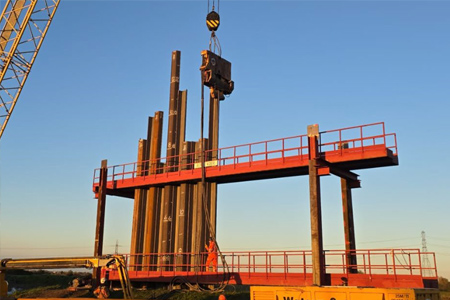
The piles were pitched through a bespoke double level conventional gate which was designed and fabricated by our in-house team at our port-side facility in Ipswich.
The main foundation works for the tidal barrier will begin in April 2025, with the construction of three cofferdam structures and installation of a bypass channel and associated excavation.