Case Study Overview
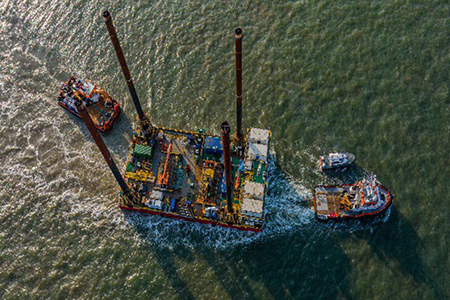
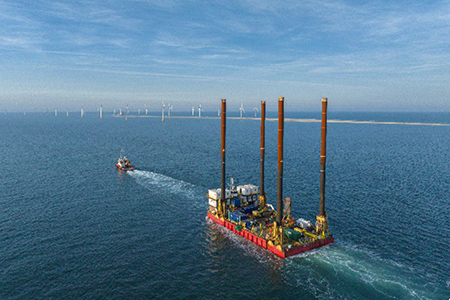
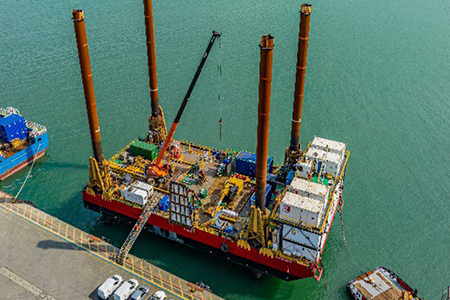
Red7Marine’s 1,000t Haven SeaChallenger jack-up barge has been working on behalf of directional drilling specialist AMS No-Dig and end client Orsted, on the installation of three HDD ducts, which will act as the protective sleeve for the offshore power cable for Hornsea 3 Offshore Windfarm. These operations are key in the lead up to the installation of the offshore cable which will bring energy from the offshore wind farm to shore once it is constructed.
At a glance
- Location: Weybourne, North Norfolk
- Plant used: 1,000T jack-up barge, Haven SeaChallenger
- What we did: Red7Marine supported AMS No-Dig with the installation of three HDD ducts, which will act as a protective sleeve for the offshore power cable for Hornsea 3 Offshore Windfarm.
HORNSEA 3 HDD DUCT INSTALL
The project has involved a significant level of engineering support from our in-house team throughout the pre-construction phase and live works. This has included:
- Assisting with the comprehensive duct installation package
- Detailed deck plans and site-specific assessments
- Sea-fastening design and installation of grillages, twist locks, and welding for stinger interfaces
- Lift plans accommodating a 70t crawler crane on deck
- GNSS positioning system installation
- Assisting AMS in the fabrication and installation of cable chute/roller mounts, stinger mounts, and deck accommodation grillage
The Solution
Tugboats towed the floating pipe to the SeaChallenger prior to the installation back to the beach at Weybourne; an operation that was repeated three times to complete this phase of the project. The SeaChallenger’s positioning system allowed the barge to be located within millimetre accuracy – this was crucial to the success of the drilling and duct installation, ensuring that vital components did not exceed the minimum bend radius, which could have resulted in failure. Following extensive calculations, the drill string was pushed out and recovered to the deck of the barge, where the tooling changes took place to enlarge the bores. This was achieved via a bespoke hinged stinger and A Frame arrangement, designed and fabricated by AMS to allow vertical stowing when under tow and rapid deployment when positioned on site, cutting down on preparatory work offshore and improving safety and efficiency.
The construction method involved drilling pilot bores using a gyroscopic steering method under the ground and seabed so that the cable ducts could be pulled through. The same process is being used along the onshore cable route and avoids some of the surface disruptions caused by traditional open trenching. A hydraulic rock drill string was pushed out 800 metres from the shore to reach SeaChallenger, where the direction was controlled, and it was steered up and punched out from the seabed.
The method used a 250t drilling rig in the Transition Joint Bay area to drill a small diameter bore from shore, which confirmed the designed alignment and was reamed using a bottom hole assembly to suit the duct outside diameter. This opened up to receive the 1km long ducts with a diameter of 450mm made at PipeLife in Norway before being stored in Scapa Flow.
The ducts were then towed down one at a time to site before being installed over the deck of SeaChallenger using depth assembly to the Bottom Hole Assembly, using Leask Marine and its diving spread, before being retracted through to the landside and capped ready for the Ørsted offshore team to install the cables. Work on Hornsea 3 is progressing, with ongoing activity this year on the onshore cable route and the construction of the Battery Energy Storage System, which will be co-located with Hornsea 3 at the Onshore Substation site in Swardeston, south of Norwich.